

IS IT AND... The Beatitudes
A look at the Beatitudes through the ISIT Construct, revealing the hidden divide between finite and infinite worldviews — and why that single assumption determines how you live.

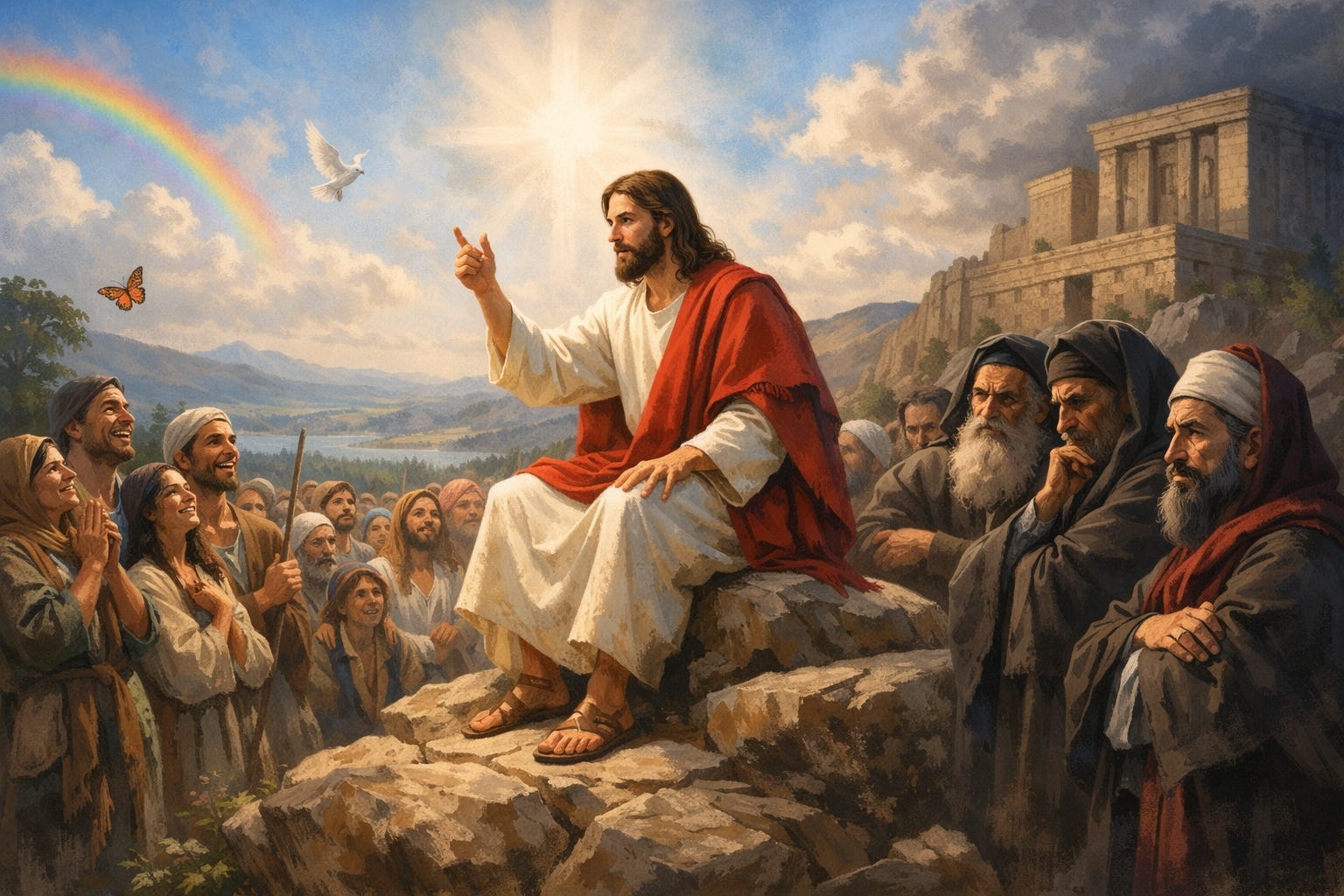
There is a fundamental divide running through humanity that rarely gets named directly.
It sits beneath religion and beneath science.
Beneath politics, morality, and culture.
Beneath optimism and despair.
That divide comes down to a single, quiet question:
Is this physical reality all there is — or is it one layer of something infinite?
Whether we realize it or not, every one of us answers that question.
And the answer we give determines everything that follows.
Two Types of Reality Assumptions
There are people who believe that this universe — governed by physics, mathematics, and immutable laws — is the ultimate reality.
From that perspective:
You are born
You live
You die
End of story
This view is common among atheists, existentialists, nihilists, and hard-core materialists. It is internally consistent, intellectually defensible, and profoundly IT-centric.
Reality is what can be measured.
Meaning must be manufactured.
Infinity is either incoherent or irrelevant.
Then there are those who sense — intuitively or explicitly — that this world is not the end of the line.
That existence unfolds across infinite depth, infinite possibility, infinite becoming.
From that perspective:
This life is a chapter, not the book
What we do matters beyond immediate outcomes
Development, awareness, and alignment compound
This view is IS-forward by nature, because once Infinity is admitted, something profound becomes unavoidable:
An infinite reality necessarily contains infinite realms.
There is no halfway position here.
Why Infinity Changes Everything
If you reject Infinity, then meaning cannot be intrinsic.
It must be:
Created
Asserted
Defended
Replaced when it collapses
Life becomes a short-term optimization problem:
Maximize pleasure
Minimize pain
Accumulate security
Distract yourself from the clock
None of this is “wrong.”
It is simply what follows logically from a finite model of reality.
But if you accept Infinity — even reluctantly — everything flips.
Suddenly:
Actions echo beyond their immediate effects
Awareness itself becomes the scarce resource
Growth is no longer optional — it is inevitable
You are no longer playing a one-move game.
You are playing the long game.
This Is Where the Beatitudes Enter
The Beatitudes make no sense whatsoever in a finite, IT-only universe.
In fact, they sound absurd.
“Blessed are the poor in spirit…”
“Blessed are the meek…”
“Blessed are those who mourn…”
From a materialist frame, these are losing positions.
Why embrace humility if there is nothing beyond this life?
Why relinquish power if dominance secures survival?
Why mourn deeply if suffering has no redemptive arc?
If this world is all there is, then the Beatitudes are not wisdom — they’re malpractice.
But Jesus was not speaking from a finite model of reality.
He was speaking from Infinity.
The Beatitudes Are Not Moral Advice — They Are Ontological Truths
This is the key that unlocks them.
Jesus is not telling people how to behave in order to be rewarded later.
He is describing what alignment looks like in an infinite reality.
Take this line:
“Blessed are the poor in spirit, for theirs is the kingdom of heaven.”
“Poor in spirit” does not mean weak, broken, or deprived.
It means unburdened by rigid identity.
Unattached to certainty.
Open to something larger than the self.
In ISIT terms:
IS is unobstructed
IT is held lightly
That state is already aligned with an infinite Reality — regardless of circumstances.
Meekness and the Long Game
Another famous example:
“Blessed are the meek, for they shall inherit the earth.”
This statement only works if time — and reality — extend far beyond the immediate moment.
Meekness is strength without compulsion.
Power that does not need to dominate.
Agency that trusts Reality instead of trying to conquer it.
In a short, finite game, this looks foolish.
In an infinite game, it is optimal.
Because in the long run — the very long run — alignment always outperforms force.
Finite Coping vs Infinite Strategy
Here’s the uncomfortable truth:
People who see a finite world are forced to invent coping mechanisms.
They must extract meaning from:
Consumption
Achievement
Status
Ideology
Distraction
Again, this is not a moral criticism.
It is a logical consequence of a closed system.
But people who see infinite possibility are doing something else entirely.
They are:
Cultivating awareness
Refining intention
Playing for coherence, not conquest
They are optimizing for becoming, not just having.
As the line goes — and yes, Gladiator said it well:
What we do in this life echoes in eternity.
That line only sounds poetic if you don’t believe it’s literally true.
IS IT AND… The Beatitudes
Seen through the ISIT Construct, the Beatitudes are not mystical riddles.
They are a sorting mechanism.
They quietly separate:
Those playing a finite game
From those who sense an infinite one
They describe what human beings look like when they orient themselves toward Infinity instead of clinging to form.
IS before IT.
Alignment before outcome.
Awareness before control.
And they leave us with a question that no one can avoid forever:
Is this world all there is — or is it just one step in a very long journey?
Because once you answer that honestly, your entire strategy for living will be clear.
In the next piece, we’ll turn to Ecclesiastes, which approaches this same Reality from inside time itself — cycles, seasons, cause and effect — and shows what infinite meaning looks like when filtered through a very finite world.
Same Reality.
Different vantage point.
As always:
IT IS what IT IS.
You've given me my truth for the day: "...in the long run... alignment always outperforms force."